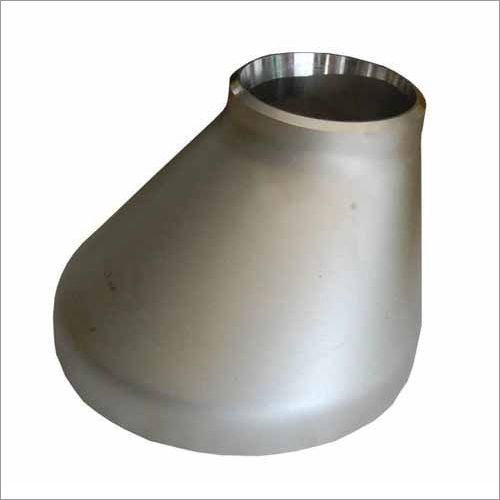
Buttweld ASME B 16.9 Reducer
We are providing the finest quality of Buttweld ASME B 16.9 Reducer matches that are popular in the markets. Our offered items are appreciated by the customers because of their efficiency and reliability. Each item is prepared by our partners under the supervision of QC experts who abide by all the industry standards as well as policies. For verifying the quality of each Buttweld ASME B 16.9 Reducer, we examine their functionality, design and durability before the dispatch of mentioned product.
Specification
| End Connection Type | Buttweld |
| Usage/Application | Oil and Gas Pipeline |
| Size | 1/2 Inch to 48 Inch |
| Material | Stainless Steel |
| Reducer Type | Eccentric |
Type :
Seamless / erw / welded / fabricated
Schedule :Sch20, sch30, sch40, std, sch80, xs, sch60, sch80, sch120, sch140, sch160, xxs
Form :
Eccentric reducer, concentric reducer
Standard :
astm / asme a/sa 403 gr wp "S" "W" " wx"
Grade :
304, 304l, 304h, 309s, 309h, 310s, 310h, 316, 316ti, 316h, 316l, 316ln, 317, 317l, 321, 321h, 347, 347h, 904l
Duplex steel reducers :Standard :
astm / asme sa 815
Grade :
uns no.S 31803, s 32205
Aluminium reducers :Standard :
astm / asme sb361
Grade :
3003 h18 , 3003 h112, 6061 t6, 6063 t6, 6351 t5, 6351 t6
Titanium reducers :Standard :
astm / asme sb363
Grade :
gr1,gr2,gr5,gr7,g9,gr12, gr23
Carbon steel reducers :Standard :
astm a 234 wpb /mss-sp-75
Grade :
wpbw, wphy 42, wphy 46, wphy 52, wph 60, wphy 65 & wphy 70.
Low temperature carbon steel reducers : Standard :
a420 wpl3/a420 wpl6
Alloy steel reducers :Standard :
astm / asme a/sa 234
Grade :
wp 1, wp 5, wp 9, wp 11, wp 12, wp 22, wp 23, wp 91.
Copper nickel reducers :
C70600(90:10), c71500(70:30), c71640.
Nickel alloy reducers :Standard :
- astm / asme sb 366
- uns 10276 (hastelloy c 276)
- uns 2200 (nickel 200 )
- uns 2201 (nickel 201 )
- uns 4400 (monel 400 )
- uns 8020 (alloy 20 / 20)
- uns 8825 inconel (825 )
- uns 6600 (inconel 600)
- uns 6601 (inconel 601 )
Buttweld ASME B 16.9 Reducers offer reliable solutions for connecting pipes of differing diameters in industries like petrochemicals, oil & gas, and water treatment. Available in both concentric and eccentric forms, these fittings accommodate seamless integration into various piping layouts while ensuring a secure, leak-free connection.
Each reducer is crafted from precision alloy, carbon, or stainless steel in adherence to ASME B16.9 and ASTM standards. Advanced methods-seamless or welded-are utilized, and comprehensive hydrostatic, PMI, UT, and RT testing is performed to certify product integrity and compliance with ANSI, DIN, EN, and JIS requirements.
These reducers are engineered to withstand temperatures ranging from -20C up to 600C and support pressure classes from 150 to 2500, depending on the selected material and grade. Their enhanced corrosion and heat resistance make them dependable for demanding industrial environments.
FAQ's of Buttweld ASME B 16.9 Reducer:
Q: How is a Buttweld ASME B 16.9 Reducer typically installed in a piping system?
A: A Buttweld ASME B 16.9 Reducer is installed using butt welding, where its beveled ends (as per ASME B16.25) are welded directly to the pipes. This creates a strong, homogeneous connection that can handle high pressure and temperature applications.
Q: What are the main differences between concentric and eccentric reducers?
A: Concentric reducers align the centerlines of both ends, ideal for vertical installations or where symmetrical flow is important. Eccentric reducers have one edge parallel, making them suitable for horizontal piping to prevent air accumulation or for applications where maintaining the bottom level of the pipe is necessary.
Q: When should I choose a seamless versus welded reducer?
A: Seamless reducers are preferable for high-pressure, critical, or corrosive applications due to their superior strength and uniformity. Welded reducers are suitable for less demanding conditions, offering cost-effectiveness while still complying with all required standards.
Q: Where are Buttweld ASME B 16.9 Reducers commonly used?
A: These reducers are widely used in industrial piping systems such as oil & gas refineries, petrochemical plants, power generation facilities, water treatment plants, and chemical processing lines for altering pipe diameters and regulating fluid flow.
Q: What testing processes ensure the quality of these reducers?
A: Quality is assured through tests like hydrostatic pressure testing, Positive Material Identification (PMI), Ultrasonic Testing (UT), and Radiographic Testing (RT), following international standards to guarantee strength, material composition, and safety.
Q: What benefits do customers gain from using these reducers?
A: Customers benefit from reliable size transition, versatile compatibility with various industry standards, resistance to extreme temperatures and corrosion, and the ability to customize dimensions or finishes as needed, enhancing system performance and longevity.